

Gawe
Visit Project
Short Explanation
Gawe is an offline-first Progressive Web App (PWA) that bundles 70+ browser-based utility tools into a single, installable app that runs in your browser. From unit converters to quick generators to even Kanban Board task tracker, Gawe lets users perform everyday micro-tasks entirely in the browser, without needing an internet connection or juggling dozens of single-purpose websites. Every tool runs client-side, meaning no data ever leaves the user's device — addressing both the friction of ad-heavy "online tool" websites and growing privacy concerns around casual data processing.
Project Goals
The primary goal of Gawe was to consolidate the scattered, ad-riddled landscape of "online tool" websites into one clean, fast, and trustworthy hub. To do this, I focused on three things: building a genuinely offline-first experience via service workers so tools remain usable without connectivity, keeping every tool's computation local to the browser for privacy and speed, and designing a scalable architecture that could support dozens of tools without the app becoming bloated or slow to load.
Tech Stack Used
The Gawe project was developed using a variety of tech stacks, including:
- Next.js & React 19: Frontend framework powering a fast, component-driven architecture that scales cleanly across 70+ individual tools.
- TypeScript: For type safety across a large, multi-tool codebase where consistency and maintainability matter as the tool count grows.
- Tailwind CSS 4: For rapid, consistent UI styling across every tool page.
- Service Workers & PWA APIs: To enable offline-first functionality, asset caching, and installability on both desktop and mobile.
- WebAssembly (WASM): Used in select compute-heavy tools to offload processing to near-native speed directly in the browser, keeping everything client-side.
- Coolify & Docker for open source and self-hosted continuous deployment for full control over performance and privacy;
Features
Here are some of the key features of the Gawe App:
70+ Browser-Based Tools
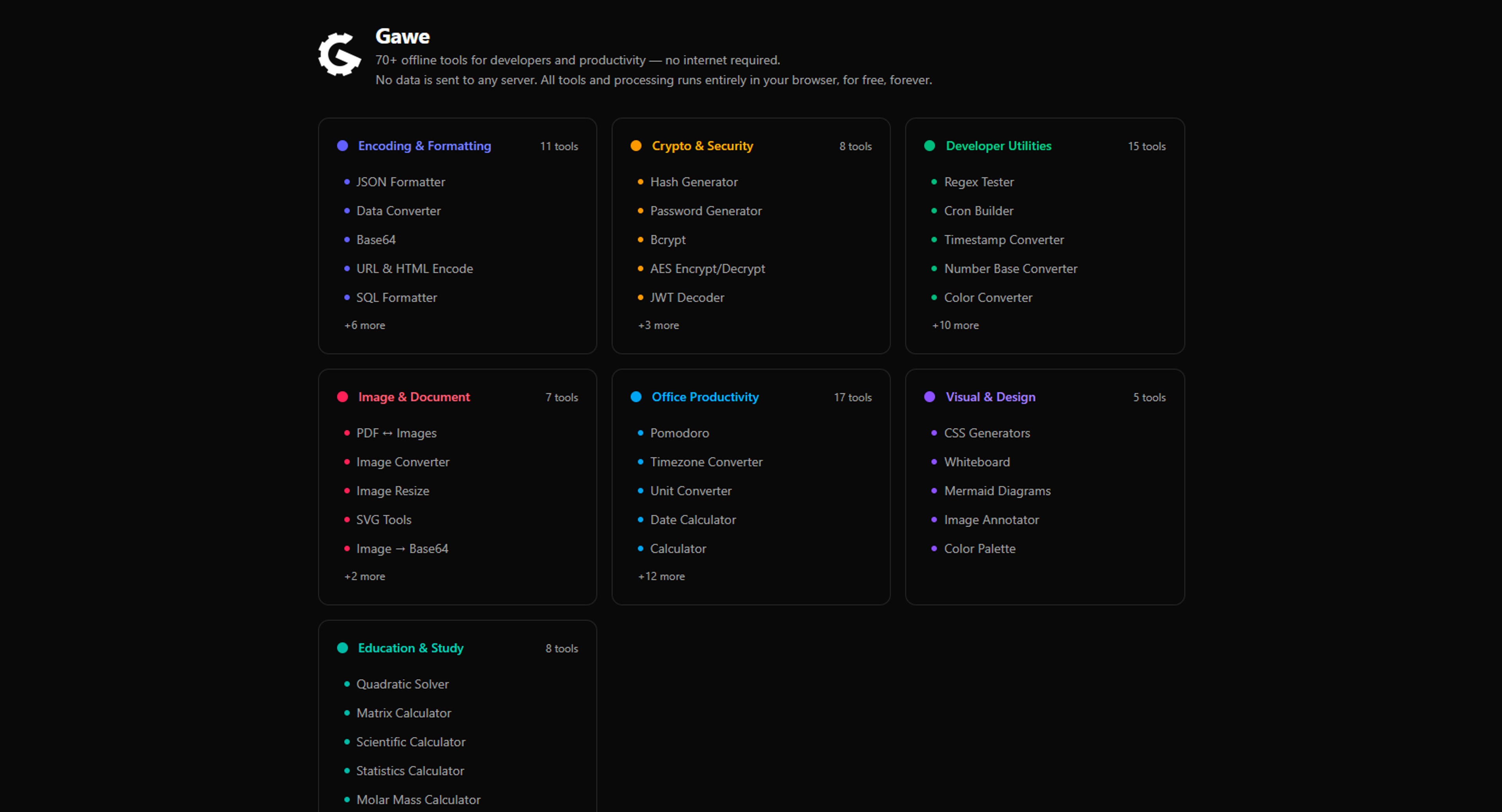
Gawe houses a growing library of tools spanning office tools, developer tools, finance tools, and even design and education-based tools — all accessible from a single, unified interface instead of scattered across dozens of ad-laden third-party sites. From converters, calculators, text processors, down to color wheel and free whiteboard, we have it all and combine it into single fast, offline-capable hub.
Offline-first Architecture
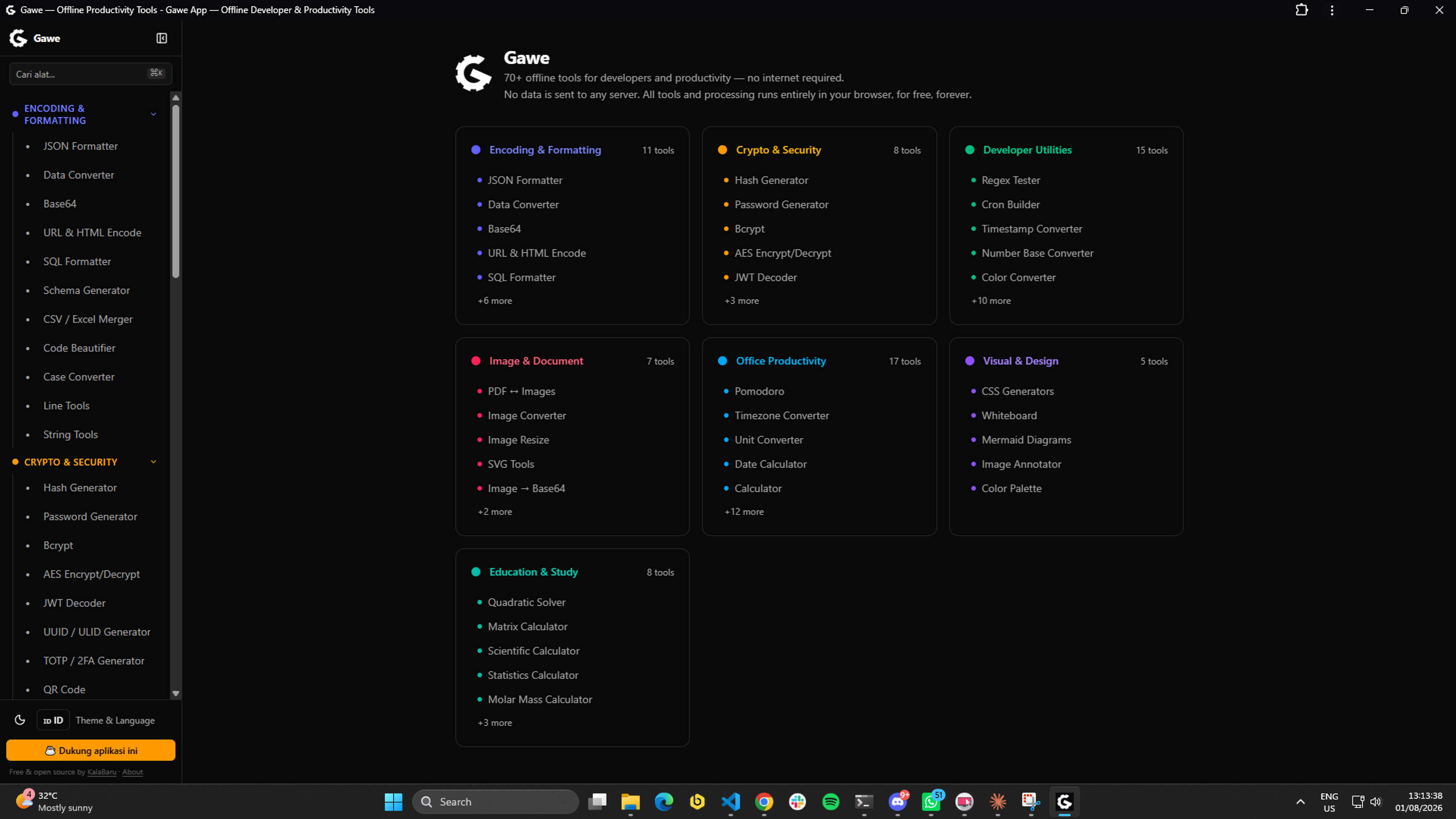
Thanks to service worker caching, Gawe tools remain fully functional even without an internet connection. Once installed (or even just loaded once), the app behaves like a native utility app, letting users get work done anywhere.
Privacy by Design
Gawe is also intentionally built with no database and no server communication — after the initial page load, the app never talks to a server again. Every tool runs and computes entirely client-side, so there's nothing to fetch, sync, or fail on. This isn't just a performance choice — it means your data never leaves your device, and Gawe keeps working exactly the same whether you're on a plane, in a basement, or have no signal at all.
Performance at Scale
By leveraging WASM for compute-intensive tools and a lightweight component architecture for the rest, Gawe keeps load times fast even as the tool library continues to grow.
Lesson Learned
Gawe was primarily a project to test my ability to architect and scale a multi-feature product from the ground up as a solo full-stack engineer — balancing offline capability, performance, and a codebase that could grow to dozens of tools without collapsing under its own complexity. Beyond the technical build, Gawe was also my first real experience initiating and maintaining an open-source project. Releasing Gawe publicly under the MIT license at github.com/kalabaru-apps/gawe meant thinking beyond just "does it work" — I had to consider documentation, contribution guidelines, code readability for strangers, and how to structure the repo so new tools could be added without stepping on each other. It's an ongoing lesson in balancing ownership of a product with the openness needed to invite outside contributions, and a step toward building in public rather than just shipping in private.
Attribution
Gawe is inspired by the broader ecosystem of open-source "online tools" projects, reimagined with an offline-first, privacy-focused approach. It is open source and open to feedback or contributions. Deployed live at https://gawe.kalabaru.id/; open to feedback or collaborations.


